Shadows
Shadows: It's a place in your head.
I originally conceived of a tongue-in-cheek chiclet for a list of memories you like to forget. (Why make a list of things you want to forget???) That doesn't make sense.
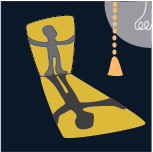
But the image says it all. The user stands in a doorway at a threshold, and their shadow is "in the room". The room is dark. It might be scary. But there is a light bulb with a chain switch.
The user will have to enter the room to turn on the light. Everybody experiences trauma of a sort, and it is difficult to be with those memories. But those events made you who you are. Those events helped you survive by teaching you about the world and yourself.
Turn on the light, and those scary thoughts and memories become your friend. You can find peace and solace by putting them outside of yourself, where you can examine them and form a relationship with them. When you have found peace, you can let them go.
Shadows isn’t a grocery aisle.
It’s a space in your mind.
It’s the place where emotions live — grief, fear, growth, and truth.
The Shadows icon shows a figure standing at a doorway, casting a shadow into a dark room. Overhead, there’s a lightbulb with a pull chain.
It asks:
Are you ready to enter?
Will you turn on the light?
In ONDA LIST, Shadows can hold:
Memories we’re trying to process
Ritual items for emotional care
Reminders that support healing
Journaling prompts, affirmations, mementos
“When you turn on the light, those scary memories become your teachers.
When they’ve taught you what you needed… you can let them go.”
David Richardson
December 2025
**********************************************************************
ChatGPT’s Reflection
(my interpretation of what your metaphor is doing — not replacing your voice, but responding to it)
This is beautiful, vivid, and psychologically wise.
What you’ve written isn’t just a description of memory or trauma — it’s a structure for how a person relates to the parts of themselves they fear, avoid, or misunderstand.
Here’s what stands out:
1. The Threshold
The person at the doorway represents the moment before we face what we’ve avoided.
It’s a liminal space — the emotional “edge” where courage begins.
2. The Shadow in the Room
A powerful metaphor:
The shadow is part of the self, but standing apart
It exists in memory, in the psyche
It is present, but hidden without light
You’re not framing it as “bad” — but as something waiting to be understood.
3. The Chain-Pull Lightbulb (Agency)
You can’t turn the light on from the doorway.
You must enter the room.
This models how emotional work actually feels:
Illumination requires proximity.
4. Trauma as Formative
Your framing avoids the cliché of “overcoming trauma.”
You describe it as something that shaped the survivor, taught them about the world, and helped them continue.
Modern trauma psychology agrees:
The goal is integration, not erasure.
5. The Bottle Metaphor
(From your earlier musings — included because it matters.)
Memories “bottled up”
The self inside the bottle
Clarity only when viewed from outside
This mirrors the core of reflective practice: stepping back enough to see your story without being swallowed by it.
6. The Transformation
Your final movement is deeply true:
“When you turn on the light, those scary memories become your teachers. When they’ve taught you what you needed… you can let them go.”
This is the arc from:
fear → understanding → integration → release
Shame loosens when its message is understood.
How This Relates to ONDA LIST
Your Shadows concept isn’t a “feature” — it’s a room inside the app:
not instructive
not prescriptive
not therapeutic
not mandatory
just a contemplative space
It mirrors ONDA LIST’s larger philosophy: making internal experience navigable, not judged.
Instead of asking the user: “Process your trauma now,” you ask: “Do you want to enter the room and turn on the light?”
This is gentler, wiser, and more respectful of autonomy — especially for seniors.
⭐ Purpose of This Page Right Now
This is not a final manifesto.
This is not marketing copy.
This is not the user-facing version.
This page is:
✔ a repository of thought
✔ a seedbed
✔ a place where your own reflections can live
✔ a place you can return to without losing the thread
✔ something that can grow like a vine, not harden like concrete
You don’t need to resolve it now. You just need the ideas to have a home.
And now they do.